
Explore / Tools
917 Developer Tools (2026)
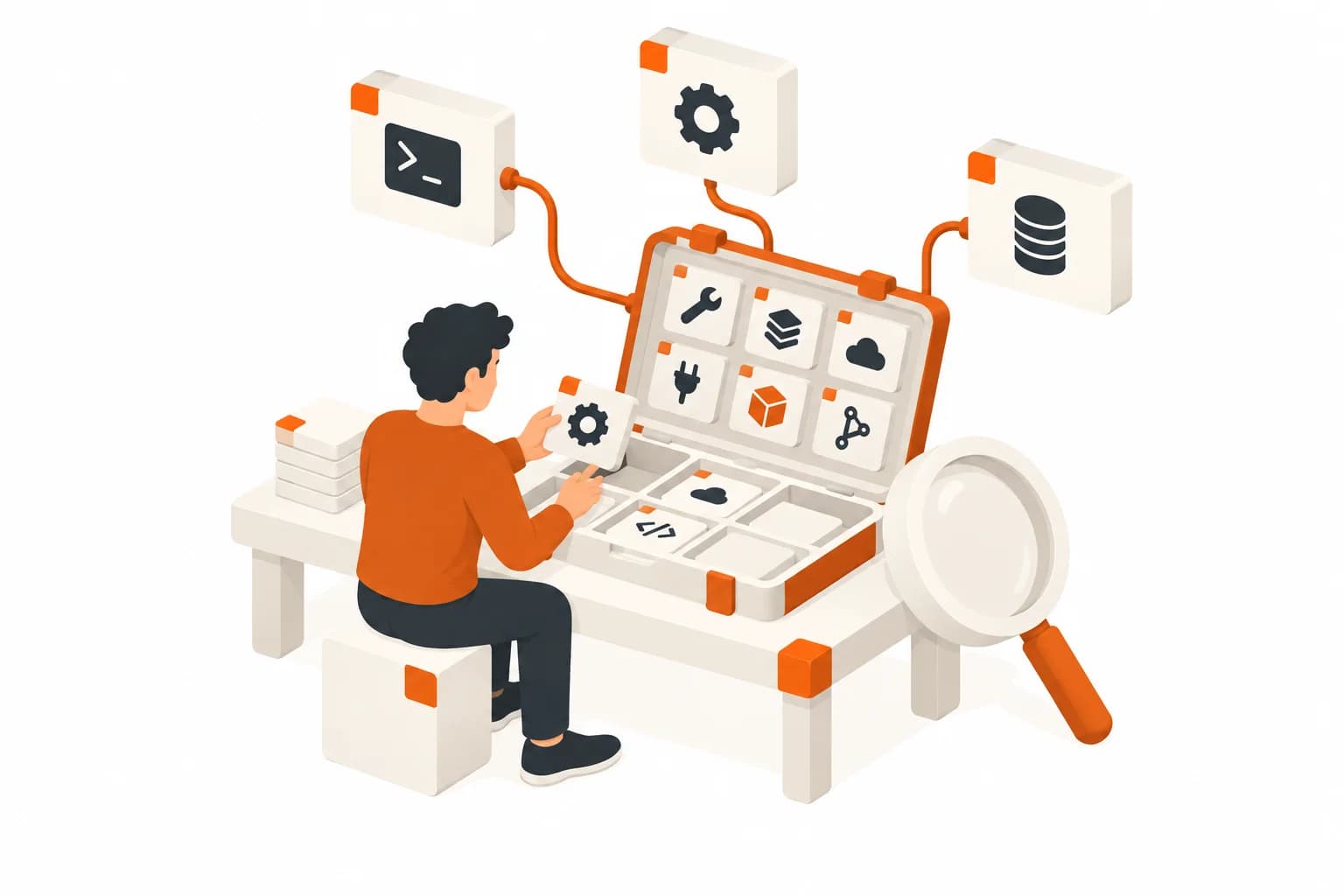
Explore the developer tool catalog, from coding assistants and editors to terminals, data tools, and deployment platforms. Use search and filters to narrow the list, then open a tool to examine its capabilities, pricing information, and available editorial coverage in context.
917 tools indexed
showing 48 of 917 tools
Go implementation of the Model Context Protocol SDK
mcp-go is a Go implementation of the Model Context Protocol, providing both server and client SDKs for building MCP integrations in Go. It supports stdio and SSE transports, resource management, tool registration, and prompt templates. Designed for Go developers building MCP servers for DevOps tools, CLI applications, and backend services. Over 8,000 GitHub stars.

DiskANN-powered vector search extension for PostgreSQL
pgvectorscale is an open-source PostgreSQL extension from Timescale that complements pgvector with DiskANN-based approximate vector search. It is useful for teams that want faster embedding retrieval while keeping vectors, filters, and application data inside the Postgres ecosystem instead of adopting a separate hosted vector database.

AI pair programming in your terminal
Terminal-based AI pair programmer with deep git integration. Auto-commits changes with meaningful messages and creates repository maps for navigating large codebases. Works with Claude, GPT, DeepSeek, and local models. One of the most popular open-source AI coding tools, known for its reliability, broad model support, and seamless command-line workflow.

Build and deploy AI chatbots and agents visually
Botpress is a conversational AI platform founded in 2017 that combines a visual Agent Studio with LLM-native architecture for building chatbots and autonomous agents. It offers a drag-and-drop flow builder, knowledge base indexing from documents and websites, an Autonomous Engine for generative AI workflows, and deployment across web chat, WhatsApp, Telegram, Slack, and other channels. Botpress runs as a cloud SaaS or self-hosted via Docker with pricing starting at $0/month pay-as-you-go.

Cloud browser automation via MCP for scalable testing
Browserbase MCP Server gives MCP clients a hosted or self-hostable browser through Browserbase and Stagehand. It exposes tools for starting sessions, navigating, acting, observing, extracting, and taking screenshots, with a hosted Streamable HTTP endpoint for easiest setup and local STDIO/Docker options for teams that want to run the Apache-licensed server themselves.

Git-native AI agent session capture and reasoning traceability
Checkpoints by Entire captures the full reasoning context behind AI-generated code directly in Git. Entire records transcripts, prompts, files touched, token usage, and tool calls alongside every commit. Session metadata lives on a separate branch keeping your history clean, with rewind capabilities to restore any previous agent checkpoint when things go sideways.
Fast, native terminal emulator
GPU-accelerated terminal emulator written in Zig by Mitchell Hashimoto (HashiCorp co-founder). Native UI rendering on macOS and Linux. Supports ligatures, true color, Kitty graphics protocol, and splits/tabs. Configurable via a simple key-value file with sensible defaults. Open-source with 20K+ GitHub stars and a focus on correctness, speed, and minimal resource usage. Growing as a modern alternative to iTerm2, Alacritty, and WezTerm.
Context compression for LLM apps and coding agents
Headroom is an Apache-2.0 context compression layer for LLM apps and coding agents. It compresses tool output, logs, files, RAG chunks, and agent history through a local library, proxy, wrapper, or MCP server, with retrieval hooks for bringing originals back when needed. Treat its savings numbers as Headroom-reported benchmarks, not independent aicoolies measurements.
HyperDX is the ClickStack UI for ClickHouse-backed observability. It provides a frontend for exploring logs, traces, metrics, session replay, dashboards, and alerts, with an OpenTelemetry-centered deployment path for teams that want a self-hosted or ClickHouse-aligned observability stack.

Knowledge graph-powered RAG framework from HKU
LightRAG is a research-backed RAG framework from Hong Kong University that combines knowledge graph structures with vector search for more contextual retrieval. Published at EMNLP 2025, it extracts entities and relationships from documents to build a structured knowledge graph, then uses dual-level retrieval across both graph and vector representations with five query modes: naive, local, global, hybrid, and mix.

Open-source AI coding agent for the terminal
Open-source terminal-based AI coding agent built in Go by the SST team, with a rich TUI (Bubble Tea) supporting 75+ model providers including OpenAI, Anthropic, Gemini, Bedrock, Groq, and OpenRouter. Features vim-like editing, persistent SQLite sessions, and LSP integration for 40+ languages. Fully free with no vendor lock-in, it has rapidly grown to 95k+ GitHub stars.

Open-source Terraform fork — community-driven Infrastructure as Code.
OpenTofu is an open-source fork of Terraform created by the Linux Foundation after HashiCorp switched Terraform to the BSL license. Designed to preserve existing Terraform workflows and configurations, it offers state encryption, early variable evaluation, and a community-driven development model. Backed by major cloud providers and companies.

One tool for intercepting, mocking, and replaying HTTP — acquired by BrowserStack
Requestly is a BrowserStack-backed API client, HTTP interceptor, mock server, and session replay tool for frontend and QA teams. Its current product is commercial/API-client led, while the legacy interceptor/open-source code is AGPLv3. The free plan covers individual workflows, and Pro lists at $12/user/month monthly or $9/user/month annually for collaborative QA and frontend debugging teams.

LLM evaluation and tracking with RAG triad metrics
TruLens is an open-source framework for evaluating and tracking LLM experiments with feedback functions, RAG triad metrics (answer relevance, context relevance, groundedness), and Honest/Harmless/Helpful evaluations. Features a unified Metric API for systematic evaluation of RAG pipelines and AI agents. 3,200+ GitHub stars, MIT licensed. Snowflake partnership adds enterprise integration. Supports LangChain, LlamaIndex, and custom LLM applications.

Cross-agent messaging for CLI coding agents
agmsg is an MIT-licensed Bash and SQLite messaging layer for CLI coding agents. It lets Claude Code, Codex, Gemini CLI, GitHub Copilot CLI, Antigravity, OpenCode, Hermes, and other terminal agents exchange messages through a shared local database instead of relying on a human copy-paste relay. It is intentionally not MCP, not a broker, and not a subagent framework.

MCP, ACP and Skills support for building production coding agents — interactive or automated.
fast-agent is an Apache-licensed Python framework for building and running LLM agents with full MCP (Model Context Protocol) and ACP support. It ships with an interactive shell mode, Skills management, and multi-model routing — making it a practical platform for coding agents, workflow automation, and agent evaluation across Claude, Codex, HuggingFace, and local models.

Google’s open-source Kubernetes assistant that translates natural-language intent into precise cluster operations.
kubectl-ai is an AI-powered Kubernetes assistant from Google Cloud Platform. It acts as an intelligent interface for cluster work, translating operator intent into Kubernetes commands and workflows. The key distinction from reactive diagnosis tools is that kubectl-ai is designed as an interactive natural-language interface for planning and executing Kubernetes operations, with provider configuration and MCP-oriented workflows around the CLI.

Lightweight multi-modal agent framework
Fast, lightweight Python framework for building multi-modal AI agents, formerly known as Phidata. Includes built-in memory, knowledge bases, tools, and reasoning capabilities with 40K+ GitHub stars. Designed for developers who want to build production-ready agents quickly with minimal boilerplate, supporting structured outputs and multi-agent coordination out of the box.

Open-source backend-as-a-service platform
Appwrite is an open-source BaaS platform with 56K+ GitHub stars providing authentication, databases, storage, functions, messaging, and real-time APIs out of the box. Self-hostable alternative to Firebase with 15+ client and server SDKs. Features OAuth login with 30+ providers, document-based database with queries, file storage with image transforms, serverless functions, and push notifications. Docker-based deployment with a web console for management.

Terraform pull request automation via GitHub/GitLab comments
Atlantis is a self-hosted Terraform pull request automation tool that runs plan and apply operations triggered by GitHub, GitLab, Bitbucket, or Azure DevOps comments. Type 'atlantis plan' on a PR to see infrastructure changes, then 'atlantis apply' to deploy. 9,100+ GitHub stars, Apache 2.0 licensed. Widely adopted as the standard for GitOps-style Terraform workflows, with locking to prevent concurrent modifications to the same resources.

Desktop app for running AI coding agents in parallel
Baton is a desktop application for running multiple AI coding agents in parallel inside isolated git worktrees. It supports Claude Code, Codex CLI, OpenCode, Gemini CLI, visual diffs, status notifications, MCP server support, built-in Git operations, and one-click PRs to GitHub or GitLab.

All-in-one AI code review, security, and quality
CodeAnt AI combines AI code review, SAST, secret detection, IaC security, policy enforcement, compliance dashboards, and agentic pentesting in one platform for engineering teams that want code quality and security checks before production.
Tool infrastructure for AI agents
Composio connects AI agents to 1,000+ app toolkits with managed auth, delegated user connections, sessions, tool search, MCP gateway support, CLI workflows, and sandboxed workbench execution. It targets developers building Claude, Codex, Cursor, LangChain, CrewAI, OpenAI Agents SDK, and custom agent workflows that need authenticated business actions without hand-rolling every API integration.
High-performance open-source web crawler optimized for AI pipelines
Crawl4AI is an open-source Python web crawler built for AI and data-pipeline use cases. It produces LLM-ready Markdown, supports structured extraction, Playwright/browser automation, deep/adaptive crawling, proxy/security controls, anti-bot fallback patterns, and multiple output formats. With 68K+ GitHub stars and Apache-2.0 licensing, it is a strong local/self-hosted option for RAG datasets and agent data collection.

Open-source vulnerability management aggregator
DefectDojo is an open-source vulnerability management platform with 4.7K+ GitHub stars that aggregates findings from 200+ security tools into a single view for ranking, triaging, and tracking remediation. It serves as the operating system for security teams by normalizing data from SAST, DAST, container scanners, and dependency checkers into a unified workflow with deduplication and metrics.

Open-source agentic development environment for parallel AI agents
Open-source agentic development environment for running multiple coding agents in parallel using isolated Git worktrees.

Open-source ML and LLM monitoring with 100+ metrics
Evidently AI is an open-source platform with 100+ pre-built metrics for monitoring data quality, model performance, and data drift in AI/ML pipelines. Available under Apache 2.0 with a cloud version, it helps teams detect when production data shifts away from training distributions, LLM output quality degrades, or feature pipelines introduce anomalies that silently degrade model accuracy.

Official remote MCP server for design-to-code and write-to-canvas Figma workflows.
Figma MCP Server is Figma’s official remote Model Context Protocol surface for design-to-code agents. It gives supported clients structured design context, variables, components, selected-frame code context, Code Connect mappings, and beta write-to-canvas tools for creating or updating native Figma frames from an MCP client while keeping the workflow tied to Figma files.

CyberArk's open-source LLM fuzzing framework for AI security testing
FuzzyAI is CyberArk's Apache-2.0 framework for fuzzing LLM APIs to identify jailbreaks and related security vulnerabilities. Current README examples cover Ollama/local models, OpenAI, Anthropic, custom REST endpoints, and attacks such as ManyShot, Taxonomy, and ArtPrompt. Use it as a repeatable security-testing starting point, not a complete AI risk-management system.

Rust-native multi-agent orchestration for production
GraphBit is a Rust-native, multi-agent orchestration framework built for production. It targets the gap between Python-first frameworks like LangGraph and the operational expectations of enterprise systems — predictable memory, low latency, deterministic concurrency, and the ability to embed an agent runtime in services that already run Rust without dragging in a Python interpreter.
Community Grok terminal agent for xAI-powered coding and command-line workflows
Grok CLI is a community command-line interface for using xAI/Grok models from a terminal workflow. It fits developers who want a lightweight, scriptable Grok surface for coding help, command-line experiments, and local agent-style interactions without waiting for a heavier IDE integration. For aicoolies, it belongs in the fast-growing AI CLI agents lane beside Grok Build, Claude Code, Codex, Gemini CLI, and Qwen Code.

Open-source agentic engineering platform
Open-source agentic AI coding platform for VS Code, JetBrains IDEs, CLI, Slack, and Cloud that combines inline autocomplete, browser automation, automated refactoring, and custom planning/coding/debugging modes. Operates on a plan-act-observe-fix loop with 500+ model support (Gemini, Claude, GPT via OpenRouter). Memory Bank feature maintains repo-resident context across sessions, and codebase indexing keeps the agent grounded in your project.

Framework for LLM applications
The most widely-used framework for building LLM-powered applications, available in Python and JavaScript. Provides abstractions for chains, agents, RAG, memory, tool usage, and structured output. Integrates with 100+ LLM providers, vector stores, document loaders, and tools. LangSmith offers tracing and evaluation. LangGraph enables stateful, multi-agent workflows with cycles. 100K+ GitHub stars. The de facto standard for LLM application development despite growing alternatives like LlamaIndex.

Unified API proxy for 100+ LLMs
Drop-in OpenAI-compatible proxy supporting 100+ LLM providers with load balancing, spend tracking, rate limiting, and fallback routing. Acts as a unified gateway for all your AI model calls, letting teams switch between providers, enforce budgets, and add reliability layers without changing application code. Essential infrastructure for multi-model AI architectures.

Open-source personal AI agent for messaging apps
OpenClaw is a free, open-source AI agent framework that turns any LLM into an autonomous personal assistant accessible through messaging apps like WhatsApp, Telegram, Discord, and Signal. Running entirely on your local machine via a Node.js gateway, it connects AI models to system tools, browsers, files, and APIs for multi-step task execution with persistent memory across sessions.

Open-source search engine with vector and hybrid retrieval
OpenSearch is an Apache-2.0 distributed search engine with native vector-search support for teams that want BM25, filters, aggregations, and k-NN retrieval in the same search stack. It is distinct from Elasticsearch in the aicoolies catalog: OpenSearch is the AWS-backed open fork with its own docs, plugin path, and serverless deployment options.

100% private document Q&A powered by local LLMs
PrivateGPT enables fully private document interaction using GPT-powered RAG without any data leaving your machine. Ingest documents (PDF, DOCX, TXT, and more) and chat with them using local LLMs via Ollama or remote providers. Built on LlamaIndex with Qdrant vector storage. 57,200+ GitHub stars, Apache 2.0 licensed. The go-to solution for air-gapped environments, regulated industries, and anyone who needs document Q&A without cloud data exposure.

Alibaba's agent framework built for the Qwen model family
Qwen-Agent is Alibaba's Apache-2.0 framework for building AI agents around the Qwen model family. It supports tool use, planning, memory, RAG, Code Interpreter, Browser Assistant, MCP extras, custom tools, and Qwen Chat backend patterns with Qwen3/Qwen3.5 examples. Best fit for teams standardizing on Qwen rather than a generic multi-agent router, with 16.5K+ GitHub stars.

Microsoft’s pytest-native red teaming framework for turning AI agent safety findings into CI tests.
RAMPART is an open-source Microsoft framework for safety and security testing of agentic AI applications. It brings red-team findings into a pytest-native workflow so teams can turn prompt injection, unsafe tool use, and behavioral boundary failures into repeatable regression tests. The strongest aicoolies angle is developer workflow: RAMPART makes agent safety part of CI/CD instead of a one-off security review.
CNCF Sandbox Kubernetes alert enrichment and automation platform
Robusta is a CNCF Sandbox project that enriches Kubernetes alerts with diagnostic context and automates remediation workflows. It intercepts Prometheus alerts, attaches relevant logs, pod status, resource metrics, and troubleshooting suggestions before delivering them to Slack, Teams, or PagerDuty. Supports custom playbooks for automated incident response and AI-powered root cause analysis.

Hybrid search and ML ranking engine at scale
Vespa is an open-source serving engine with 6K+ GitHub stars for hybrid search combining vector similarity, BM25 text ranking, and structured filtering in a single query. Built by Yahoo for web-scale, it handles billions of documents with millisecond latency. Features real-time indexing, ML model serving, tensor computation, and ACID-compliant writes. Supports custom ranking models, query federation, and geographic search. Used for recommendation systems, personalization, and RAG.

LLM observability and evaluation by Weights & Biases
W&B Weave is the LLM observability and evaluation toolkit from Weights & Biases. It provides automatic tracing of LLM calls with full input/output logging, cost and latency tracking, evaluation pipelines with custom scorers, and a trace explorer for debugging multi-step agent workflows. Integrates with OpenAI, Anthropic, LangChain, and CrewAI via simple Python/TypeScript decorators.

MCP server for controlling Windows desktops through UIAutomation
Windows-MCP is an open-source MCP server for giving AI agents structured access to Windows desktop automation. It focuses on UIAutomation, snapshots, input control, and Windows-specific app workflows, making it different from general filesystem or shell MCP servers.

Run frontier AI models across a cluster of everyday devices
exo turns multiple local machines into a unified AI compute cluster for models that exceed a single device's memory. It automatically discovers devices, uses topology-aware auto parallelism to split work across available resources, and supports RDMA over Thunderbolt 5 for co-located clusters or standard networking for looser setups. The project exposes OpenAI Chat Completions, Claude Messages, OpenAI Responses, and Ollama-compatible APIs plus a dashboard for cluster management.

Open-source LLMOps platform for prompt management and evaluation
Agenta is an open-source LLMOps platform that combines prompt engineering playgrounds, prompt version management, LLM evaluation, and observability in a unified interface. It supports 50+ LLM models with side-by-side prompt comparison, A/B testing, human evaluation workflows, and OpenTelemetry-native tracing. Self-hostable with 4,000+ GitHub stars.

Multi-agent AI framework
Python framework for orchestrating autonomous AI agents that collaborate to accomplish complex tasks. Define agents with specific roles, goals, and backstories, then organize them into crews with sequential or parallel task execution. Supports tool usage (web search, file I/O, API calls), memory, delegation between agents, and human-in-the-loop input. Works with OpenAI, Anthropic, local models, and more. 25K+ GitHub stars. Leading multi-agent framework alongside LangGraph and AutoGen.

Library for efficient similarity search and clustering of dense vectors at billion-scale.
FAISS is Meta AI Research's open-source library for efficient similarity search and clustering of dense vectors. It implements approximate nearest-neighbor algorithms designed to scale to billions of vectors, with optimized indexes that fit in RAM and GPU acceleration for the largest workloads. Engineering teams use FAISS as the retrieval primitive underneath custom RAG pipelines, recommendation systems, and large-scale embedding search infrastructure.
Open-source Kubernetes security platform for risk analysis and compliance
Kubescape is a CNCF-backed open-source Kubernetes security platform that scans clusters, manifests, and container images for vulnerabilities, misconfigurations, and compliance violations. It checks against NSA-CISA, MITRE ATT&CK, and CIS benchmarks, integrates into CI/CD pipelines, and provides runtime threat detection via eBPF. Supports SBOM generation and vulnerability scanning. Used by ARMO with growing enterprise adoption in cloud-native security.