
Open Source Tools
Explore tools listed as open source and follow their project information to investigate the code, license, and available deployment options. Compare capabilities and pricing in context: an open repository does not automatically mean every feature is free or every service can be self-hosted.
917 open-source tools
showing 48 of 917 tools

AI agent that builds other AI agents
Archon is an open-source AI meta-agent created by Cole Medin that autonomously builds, refines, and optimizes other AI agents. Now evolving into Archon OS, it serves as a knowledge and task management backbone for AI coding assistants. The system uses an agentic coding workflow with framework knowledge bases for Pydantic AI, LangGraph, and other agent frameworks, enabling developers to describe what they need and let Archon generate the agent code, test it, and iterate until it works.

Open-source data curation platform for LLM fine-tuning
Argilla is an open-source platform for curating and annotating data for LLM fine-tuning and RLHF workflows. It provides collaborative annotation interfaces for text classification, ranking, and preference labeling with integrated quality metrics. Part of the Hugging Face ecosystem, Argilla supports direct dataset publishing to the Hub and integrates with major training frameworks for seamless model improvement pipelines.

Visual regression testing for CI/CD pipelines
Argos CI is a visual regression testing platform that automatically catches unintended UI changes in CI/CD pipelines. It integrates with Playwright, Cypress, Storybook, and Puppeteer, featuring a stabilization engine that filters flaky pixel differences from genuine regressions. Used by teams at Meta and MUI for frontend quality gates.

Headless UI component library for React, Vue, Solid, and Svelte
Ark UI is a headless component library providing unstyled, accessible UI primitives for React, Vue, Solid, and Svelte. Built by the Chakra UI team using state machines for predictable behavior across frameworks. Includes complex components like date pickers, color pickers, comboboxes, and tree views that are notoriously difficult to build from scratch while maintaining accessibility.

Versatile microservice framework for any protocol
Armeria is an open-source microservice framework from the creator of Netty at LINE Corporation that supports gRPC, Thrift, REST, and GraphQL on a single server and port. It provides built-in decorators for metrics, distributed tracing, load balancing, authentication, rate limiting, circuit breakers, and automatic retries. The framework integrates seamlessly with Spring Boot, Dropwizard, and Reactive Streams while serving automated API documentation with interactive request testing.
Java diagnostic and troubleshooting tool
Arthas is Alibaba's open-source Java diagnostic tool that lets developers troubleshoot production issues without modifying code or restarting servers. It attaches to running JVM processes to inspect class loading, decompile classes, trace method invocations, monitor performance metrics, and view real-time stack traces. Supports JDK 6+ with both telnet and WebSocket interfaces for local and remote diagnostics across Linux, macOS, and Windows.
Official Asana remote MCP server for project and task workflows.
Asana MCP Server is Asana's official hosted MCP endpoint for connecting compatible AI clients to Asana work data. It lets authenticated users search workspace objects, inspect and manage tasks or projects, create work items, and generate project summaries through OAuth-backed Streamable HTTP access while preserving existing Asana permissions and admin app-management controls.

Agentic IM chatbot platform with multi-platform LLM integration
AstrBot is an open-source agentic chatbot infrastructure that connects multiple instant messaging platforms including Telegram, Discord, Slack, WeChat, QQ, Feishu, and DingTalk to AI language models. It supports multi-provider LLM integration, MCP protocol, knowledge bases, persona management, multimodal input, and a plugin ecosystem with over 1,000 community extensions. Features include a web management UI, sandbox code execution, and auto-context compression for efficient conversations.
Database schema management for modern teams
Database schema management and migration tool by Ariga with a declarative schema-as-code approach. Features automatic migration planning, CI/CD integration, and drift detection to keep database schemas in sync across environments. Supports PostgreSQL, MySQL, MariaDB, and SQLite, making database changes as reviewable and version-controlled as application code.

Official remote MCP server for Jira and Confluence
Atlassian's official remote MCP server connects Jira and Confluence to LLM clients, IDEs, and agent platforms over OAuth, so Claude, Cursor, and other MCP-aware tools can search issues, read pages, and post updates inside the same permission boundaries users already have. As a vendor-hosted reference implementation, it standardizes the Atlassian side of remote Model Context Protocol deployments.

Build AI agents like LEGO — modular and predictable
Atomic Agents is a lightweight Python framework by BrainBlend AI that applies Atomic Design principles to AI agent development. Each component — agents, tools, context providers — is a single-purpose, reusable building block with Pydantic-enforced input/output schemas for type safety. Built on Instructor for structured LLM outputs, it prioritizes predictability and developer control over the autonomous-but-unpredictable behavior of larger frameworks like LangChain or CrewAI.

Magical shell history
Shell history manager that replaces the default history with a SQLite-backed, encrypted, and synchronized command history across all your machines. Features full-text search with fuzzy matching, directory-based context filtering, session tracking, and statistics about command usage. Syncs via an encrypted server (self-hostable or hosted). Supports bash, zsh, and fish shells. 22K+ GitHub stars. Transforms shell history from a simple list into a searchable, cross-machine knowledge base.
Open-source autonomous AI agent platform
AutoGPT is an open-source autonomous AI agent platform with 183K+ GitHub stars that breaks goals into subtasks and executes them independently. Features a visual Agent Builder for creating workflows without coding, persistent cloud-based agents running on triggers, a marketplace of pre-built agents, and a plugin system. Agents can browse the web, write code, manage files, and call tools autonomously while maintaining memory across sessions.

Autonomous LLM-powered terminal coding agent
Autohand is an AI platform for adaptive continuous engineering and autonomous code evolution, giving teams infrastructure to coordinate multiple AI agents inside sandboxed execution environments. Its open-source Commander tool builds command interfaces that orchestrate multi-agent workflows, while the broader platform lets agents iteratively write, test, and evolve code safely. Aimed at engineering teams pushing beyond simple code generation toward continuous AI-driven software improvement.
AI agents running automated research
Autonomous research framework by Andrej Karpathy that lets AI agents plan and execute machine learning experiments end-to-end. Agents design experiments, run training loops, analyze results, and iterate on hypotheses with minimal human oversight. Runs efficiently on single-GPU setups and applies agentic patterns beyond software development — bringing autonomous agent workflows to the research process itself.

Curated collection of agent skills and capabilities
Awesome Agent Skills is VoltAgent's MIT-licensed list of agent skills from official teams and the community for Claude Code, Codex, Gemini CLI, and Cursor.
Curated directory of terminal-native AI coding agents and orchestration tools
Living directory of 80+ CLI coding agents, orchestration harnesses, and comparison benchmarks. Includes agent managers, parallel runners, and infrastructure tools. Community-maintained reference for the agentic coding ecosystem that helps developers evaluate and choose the right terminal-based AI coding tools from an increasingly crowded and fast-moving landscape.

Curated Claude Code resources
Official Anthropic-curated list of Claude Code tips, CLAUDE.md templates, hooks, MCP servers, and community tools. Essential reference for Claude Code users looking to optimize their workflow. Covers everything from initial setup and configuration best practices to advanced patterns like custom hooks and multi-agent orchestration with the Claude Code CLI.

Type-safe LLM function builder
BAML is a domain-specific language by BoundaryML for building reliable AI workflows and agents through schema engineering. It turns prompt engineering into a structured, type-safe discipline by letting developers declaratively define function schemas, validate LLM responses, and version prompts without fragile JSON parsing or boilerplate. BAML reframes prompt engineering as schema definition, making AI workflows testable and maintainable across models.

Markdown-based project management for AI agents
A tool for managing project collaboration between humans and AI agents in a git ecosystem. Uses markdown files as the source of truth for backlogs, tasks, and progress tracking. Keeps everything version-controlled and transparent, making it easy to assign work to AI agents and review their contributions alongside human commits.
Spotify's open-source developer portal framework
Backstage is Spotify's open-source framework for building internal developer portals, now a CNCF incubating project with 27,000+ GitHub stars. It provides a unified software catalog, service documentation, CI/CD pipeline views, and a plugin architecture with 200+ community plugins. Teams use it to create a single pane of glass for service ownership, API documentation, infrastructure management, and developer self-service workflows.

Python and TypeScript framework for production multi-agent systems
BeeAI Framework is an Apache-2.0 toolkit for building production-ready AI agents and multi-agent systems in Python and TypeScript. Its docs cover agents, tools, RAG, memory, workflows, backend providers, serving, and A2A/MCP integration surfaces, making it a vendor-neutral option for teams comparing LangGraph, CrewAI, Mastra, and related agent runtimes.

Open-source SQL editor and DB manager
Beekeeper Studio is a modern, open-source SQL editor and cross-platform database GUI for MySQL, PostgreSQL, SQLite, SQL Server, MariaDB, CockroachDB, Amazon Redshift, Oracle, and LibSQL. Focuses on a clean interface, fast multi-tab editor, saved queries, data export, and schema browsing — a lightweight alternative to DBeaver or DataGrip for everyday database work on Windows, macOS, and Linux.

ML model serving and deployment framework
BentoML is an open-source framework with 7K+ GitHub stars for packaging, deploying, and serving ML models as production-ready APIs. Bundles models, preprocessing, and serving logic into portable Bento archives with auto-generated REST/gRPC endpoints. Features adaptive batching for throughput optimization, GPU scheduling, multi-model inference pipelines, and containerization. Supports all major ML frameworks including PyTorch, TensorFlow, scikit-learn, and Hugging Face Transformers.

TypeScript-native open-source auth library
Better Auth is an open-source TypeScript-native auth library with 10K+ GitHub stars providing a comprehensive, framework-agnostic solution. Features email/password, social OAuth, magic links, passkeys, 2FA, session management, and organization support. Works with Next.js, Nuxt, SvelteKit, Astro, and any Node.js framework. Database adapters for PostgreSQL, MySQL, SQLite, MongoDB, Drizzle, and Prisma. Zero vendor lock-in alternative to Clerk and Auth0.

50x faster LLM gateway with MCP support, built in Go
Bifrost is a high-performance open-source AI gateway built from scratch in Go. Unifies access to 15+ providers and 1,000+ models through a single OpenAI-compatible API with only 11 microsecond overhead per request at 5K RPS — 50x faster than LiteLLM. Features automatic failover, load balancing, semantic caching, and functions as both MCP client and MCP server. Apache 2.0 licensed.
Fast Rust-based formatter and linter for web projects
Biome is a Rust-based toolchain for JavaScript, TypeScript, JSX, JSON, and CSS that combines formatting and linting in a single tool running 20-50x faster than ESLint + Prettier. Provides 300+ lint rules with automatic fixes, opinionated formatting compatible with Prettier output, and import sorting. Zero configuration needed to start with sensible defaults. Designed as a drop-in replacement for ESLint and Prettier with first-class IDE support via VS Code and JetBrains extensions.

Microsoft's framework for running 1-bit large language models on consumer CPUs
BitNet is Microsoft's official inference framework for 1-bit quantized large language models that enables running models with up to 100 billion parameters on standard consumer CPUs without requiring a GPU. By leveraging extreme quantization where weights use only 1.58 bits on average, BitNet achieves dramatic reductions in memory footprint and computational cost while maintaining competitive output quality for many practical use cases.

Open-source password management
Open-source password manager with end-to-end AES-256 encryption, zero-knowledge architecture, and full source code on GitHub for independent security audit. Bitwarden offers cross-platform clients, auto-fill, password generator, TOTP storage, encrypted sharing, self-hosting, and enterprise features like SSO, SCIM directory sync, plus a developer secrets manager for API keys and certs.

Connect Blender to AI through Model Context Protocol
BlenderMCP bridges Blender and AI assistants like Claude through the Model Context Protocol, enabling natural language control over 3D modeling workflows. Artists and developers can create, modify, and manipulate 3D scenes, objects, materials, and animations by describing what they want instead of navigating complex menus. The tool exposes Blender's Python API through MCP, supporting operations from mesh creation to shader editing and physics simulations.
Kubernetes ChatOps bot for Slack, Teams, and Discord
Botkube is a Kubernetes ChatOps platform that brings cluster management into Slack, Microsoft Teams, and Discord. It provides real-time alerts for cluster events, enables kubectl command execution from chat, and supports automated workflows triggered by Kubernetes resource changes. Features plugin architecture for extensibility and RBAC-based access control for team collaboration.

AI code review grounded in twelve classic software-engineering books
Open-source (MIT) AI reviewer with a distinctive angle: findings are grounded in twelve classic engineering books, cited by source, and framed as decay-risk diagnostics with a 0–100 Health Score. Runs as an Agent Skill across Claude Code, Gemini CLI, Codex, and other coding agents, with GitHub Actions quality gates and SARIF output.

Automate local Chrome browser via MCP
BrowserMCP is an MCP server that enables AI agents to automate a local Chrome browser — navigating pages, clicking elements, filling forms, extracting content, and taking screenshots. It gives coding agents the ability to interact with web applications the way a human would, directly from Claude Desktop, Cursor, or any MCP client.

Open-source agentic browser that runs local AI agents in your browsing workflow.
BrowserOS is a privacy-first, open-source agentic browser for running AI assistants locally inside real browsing sessions instead of handing every task to a remote cloud browser.

All-in-one JavaScript runtime and toolkit
Bun is an all-in-one JavaScript runtime, bundler, transpiler, package manager, and test runner built from scratch in Zig for maximum performance. Starts and runs JavaScript/TypeScript up to 4x faster than Node.js with native support for JSX, TypeScript, and ESM without configuration. npm-compatible package manager installs dependencies 25x faster. Includes a built-in SQLite database, HTTP server, WebSocket support, and file I/O APIs. Drop-in Node.js replacement for most use cases.

State machine framework for AI agent tracking
Burr is an open-source Python framework for building applications as state machines with built-in observability and persistence. Designed for AI agents, chatbots, and RAG pipelines where tracking state transitions, debugging decisions, and replaying execution is critical. Features automatic state persistence, a visual UI for inspecting execution flows, time-travel debugging, and integration with LangChain, OpenAI, and any Python code. Apache 2.0 licensed by DAGWorks.

Persistent structured memory layer for AI coding agents
ByteRover CLI provides a persistent, structured memory layer for AI coding agents. It lets you curate project knowledge into a context tree that syncs to the cloud and shares across tools and teammates. Supports 20+ LLM providers with 24 built-in agent tools for code execution, file operations, and memory management. Achieves 96.1% accuracy on the LoCoMo benchmark. SOC 2 Type II certified.

Database CI/CD and DevSecOps platform at scale
Bytebase is an open-source database DevSecOps platform that automates schema migrations, enforces SQL standards across 200+ lint rules, and provides fine-grained access control with dynamic data masking. Teams use it for GitOps-based database change management, SQL review, and compliance across PostgreSQL, MySQL, MongoDB, Snowflake, Oracle, SQL Server, and 20+ other databases. Available as self-hosted Docker or Kubernetes deployment, or as a managed cloud service.

AI agent framework for offensive security and penetration testing
Alias Robotics' agent framework for building AI-driven offensive-security workflows — reconnaissance, exploitation, privilege escalation, and lateral movement — with multi-agent handoffs and human-in-the-loop control. Source-available, but the core is licensed for non-commercial research use only.

Multi-agent framework for finding scaling laws of agents
CAMEL-AI is an open-source multi-agent framework with 16,500+ GitHub stars, built by a research community of over 100 researchers focused on finding the scaling laws of agents. It supports role-playing agent societies, synthetic data generation pipelines, large-scale social simulations with up to 1M agents via the OASIS platform, and real-world task automation through the OWL project accepted at NeurIPS 2025. CAMEL works with OpenAI, Anthropic, Gemini, Mistral, and local models.

Unified desktop manager for AI CLI tools
CC Switch is a cross-platform desktop app that unifies management of Claude Code, Codex, OpenCode, OpenClaw, and Gemini CLI from a single interface. It replaces manual config file editing with visual provider management featuring 50+ built-in presets, one-click switching, unified MCP and Skills management, and system tray quick access. Its SQLite backend ensures atomic writes that protect configuration integrity across all supported tools.

HashiCorp's Cloud Development Kit for defining Terraform with code
CDKTF (Cloud Development Kit for Terraform) lets developers define infrastructure using TypeScript, Python, Java, C#, or Go instead of HCL. It synthesizes familiar programming language constructs into standard Terraform JSON configuration. Developed by HashiCorp, it brings software engineering patterns like loops, conditionals, and abstractions to infrastructure definition with full IDE support.
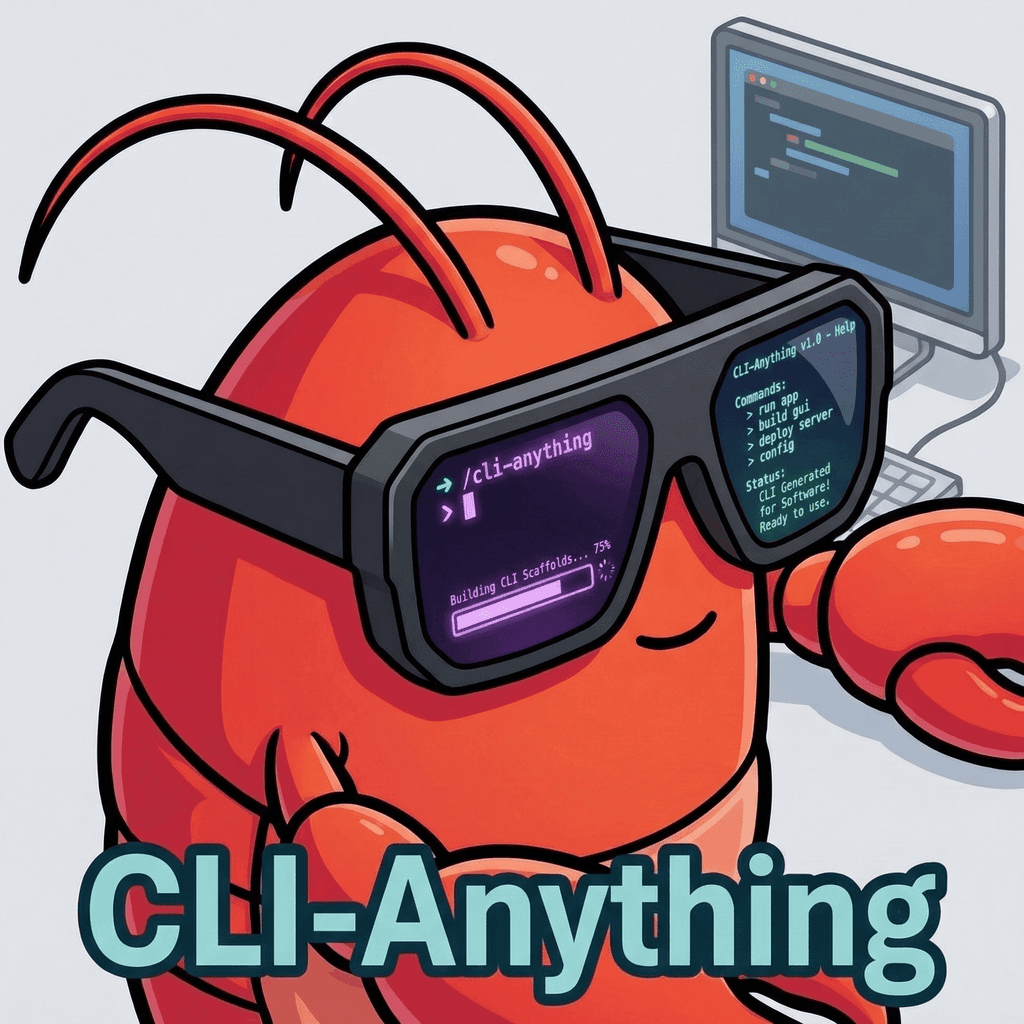
Making all software agent-native from the CLI
Universal bridge from HKUDS that makes any GUI software accessible to AI coding agents through command-line interfaces. Instead of requiring manual GUI interaction, it exposes application functionality as CLI commands agents can invoke programmatically. Addresses a core challenge in agentic development: most software targets human graphical interaction, but AI agents work best through text-based command interfaces.

On-device AI inference engine for mobile and wearable applications
Cactus is a YC-backed low-latency AI engine for mobile and wearable devices that runs LLMs, transcription, embedding, and TTS models locally. It achieves 16-20 tok/sec on older devices and 70+ tok/sec on flagships with ARM SIMD kernels optimized for Snapdragon, Apple, and MediaTek processors. Supports Qwen, Gemma, Llama, DeepSeek with Flutter, React Native, and Kotlin SDKs.

Free self-hosted PaaS
Open-source self-hostable PaaS that turns any VPS into a Heroku-style platform. CapRover wraps Docker Swarm with a friendly web UI for one-click app deploys, automatic NGINX reverse proxy with free Let's Encrypt SSL, and a one-click app store for Postgres, Redis, MongoDB, WordPress, and dozens more. Define apps via captain-definition files, scale containers, view logs, and manage volumes — all without touching the Docker CLI. Free, MIT licensed.

Simple open-source personal cloud system
CasaOS is an elegant open-source personal cloud operating system that turns any hardware into a private home server with a one-line installation. It provides a beautiful web dashboard for managing Docker containers, a curated app store with one-click installs for tools like Nextcloud and Jellyfin, and built-in file management. CasaOS runs on Raspberry Pi, Intel NUC, old laptops, and cloud VMs with full support for Ubuntu, Debian, and Raspberry Pi OS.
Open-source IAM and SSO platform by Casbin
Casdoor is an open-source Identity and Access Management platform built by the Casbin community in Go and React. Supports OAuth 2.0, OIDC, SAML, CAS, LDAP, SCIM, WebAuthn, and MFA with a comprehensive web-based admin UI. Provides multi-tenant organization management, flexible RBAC and ABAC access control via Casbin models, and integrations with Google Workspace and Azure AD. Offers self-hosted deployment with optional managed cloud plans.

Instant database schema diagrams from a single query
ChartDB is an open-source database diagramming tool that converts SQL queries into instant visual entity-relationship diagrams. It supports PostgreSQL, MySQL, SQL Server, MariaDB, SQLite, CockroachDB, and ClickHouse, enabling database engineers to visualize schemas, plan migrations, and generate DDL scripts across different SQL dialects using AI assistance. Available as a free cloud app at chartdb.io or self-hosted via Docker deployment.