
Explore / Category guide
Terminal & CLI Tools
Discover the top Terminal & CLI Tools in 2026. Compare architecture, pricing tiers, performance benchmarks, and open-source developer alternatives.
Category overviewAbout Terminal & CLI ToolsRead guideClose guide
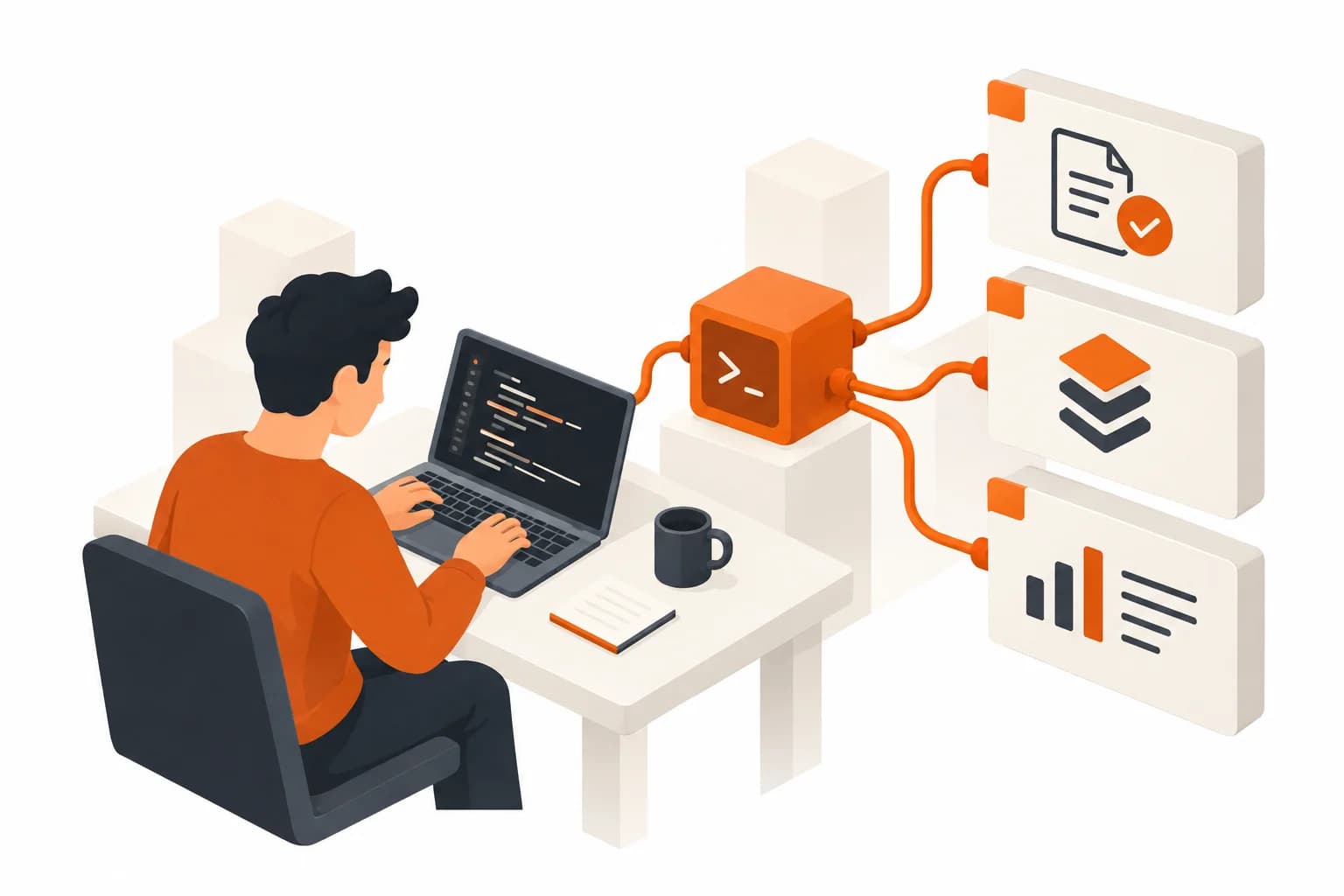
This shelf holds two things that are not substitutes for each other: the terminal you type into, and the agents that run inside it. Ghostty and Claude Code both live here and there is no version of the question where you pick one over the other. Read the category as an emulator layer plus an agent layer, and the 105 entries stop looking like a ranking. A scope note before you start: 27 of the 48 cards below also appear under AI CLI Agents, which indexes 40 tools and covers the agent half on its own. Use this page when you want both layers in one view.
For the agent layer, the axis that actually decides the purchase is who pays for inference and on what terms. Claude Code (92 in Claude Code, present in 33 of the 589 published comparisons and 20 of the 131 stacks) is bundled into a Claude Pro or Max subscription or billed through the API — you buy the model and the agent together, and you cannot swap the model. Aider (83) and Goose (84) invert that: the client is free, you bring your own key, and the bill lands with whichever provider you chose. Amp (85) sits in between with a free credit grant up to $10/day and pay-as-you-go credits at zero markup for non-enterprise users. Kilo Code (82) is free and BYOK in its open-source tier but sells Teams seats at $15/user/mo. None of these is cheaper in the abstract; the answer depends entirely on how many tokens a working day costs you.
The second thing worth checking before you commit is what the licence says rather than what the README implies. 90 of the 105 tools here (85.7%) are flagged open source, but the exceptions are not uniform. Crush (84) ships under FSL-1.1-MIT — source-available now, MIT later — which is a different risk profile from OpenCode's plain MIT. Kiro (80) and Codex (80) are proprietary clients over vendor plans. If your organisation has a policy on copyleft or on source-available licences, that policy will decide this shortlist faster than any benchmark.
Two dated changes from 2026 that a stale bookmark will not tell you. Google moved unpaid and Google One users of Gemini CLI to Antigravity CLI on 18 June 2026; the Standard, Enterprise and Google Cloud paths continue, so "Gemini CLI is free" is now true only for some readers. And Charm archived the Mods repository on 30 June 2026, with its last observed push on 2026-03-09. Mods, exa and fig are all graveyard records here and none of them appears in the grid below.
Only 32 of the 105 tools carry a scored review, so treat an unscored card as unassessed rather than weak. If you are choosing an emulator, start with Ghostty and stop; if you are choosing an agent, start from your token budget and your licence policy, then read two reviews.
showing 48 of 115 tools

Anthropic's agentic coding CLI
Anthropic's agentic CLI coding tool that delegates complex tasks to Claude directly from the terminal. Understands entire codebases via automatic context gathering, edits multiple files, runs shell commands, and manages Git workflows autonomously. Supports CLAUDE.md for persistent project instructions, integrates with VS Code and JetBrains, and uses Claude Opus/Sonnet with extended thinking for complex architectural decisions. Built for terminal-first developers.

Agentic coding tool by Sourcegraph (formerly Cody)
Amp is a multi-model coding agent for terminal, web, macOS/iOS, and IDE-connected workflows. Vendor docs describe the same agent and threads across surfaces, with remote Orbs, local Runners, Dial modes (low / medium / high / ultra), shared threads, MCP, plugins, and BYOK / linked ChatGPT subscriptions. Pricing spans a free Hobby tier, optional Megawatt ($20/mo) and Gigawatt ($200/mo) Individual plans, no-extra-charge Teams workspaces, pay-as-you-go credits, and Enterprise.

OpenAI coding agent for app, editor, terminal, and cloud work
Codex is OpenAI's coding agent for software development across the Codex app, editor, terminal, and cloud tasks. It helps write, review, debug, refactor, and automate code, with ChatGPT plan access for managed surfaces and API-key usage for CLI, SDK, and IDE workflows. The open-source CLI and SDK support local repository work, while cloud features add GitHub review, Slack/Linear integrations, worktrees, skills, MCP, and automations.
Blazingly fast recursive search
Ultra-fast recursive text search tool written in Rust that respects .gitignore rules automatically. Searches directories significantly faster than grep with smart defaults like line numbers, syntax highlighting, and compressed file support. The de facto replacement for grep among developers, combining the speed of Rust with sensible defaults that eliminate the need for complex command-line flags.

Turn GitHub repositories into interactive architecture maps
Visual architecture generator that transforms any GitHub repository into an interactive system design map within seconds. Analyzes repository structures and README documentation to produce validated component flowcharts, dependency graphs, and Mermaid diagrams. Supports direct URL routing by replacing hub with diagram, provides instant export to SVG and PNG formats, and handles private repositories through user-supplied personal access tokens.

Multi-agent orchestration plugin for Claude Code
Oh My ClaudeCode (OMC) is a plugin for Claude Code that adds multi-agent orchestration with 19 specialized agents, smart model routing between Haiku and Opus, and execution modes such as Autopilot, Team, Ralph, Ultrawork, and Deep Interview. It provides lifecycle hooks, a real-time HUD statusline, and source-backed Claude Code workflows that turn one session into a coordinated AI development team.

Open-source AI agent framework with persistent memory, reusable skills, tools, and messaging gateways
Hermes Agent is an open-source AI agent framework with persistent memory, reusable skills, 40+ tools, cron jobs, and messaging gateways.

Pack your entire codebase into a single AI-friendly file
Repomix packages entire repositories into single AI-optimized files for feeding to LLMs like Claude, ChatGPT, and Gemini. It outputs XML, Markdown, JSON, or plain text with token counting, security scanning via Secretlint, and Tree-sitter-based code compression. Works as CLI, MCP server, or Chrome extension for GitHub. Supports Claude Agent Skills generation. 26K+ GitHub stars, MIT licensed, with a web interface at repomix.com for zero-install usage.

Agentic skills framework for disciplined coding-agent workflows
Superpowers is an MIT-licensed agentic skills framework and software-development methodology for coding agents. It packages repeatable workflows such as brainstorming, specs, implementation plans, TDD execution, subagent-driven development, and structured review so teams can move from ad hoc prompting to disciplined agent-assisted software delivery.
Personal AI agent in your terminal with local tool access
gptme is one of the earliest terminal-based AI agent CLIs, launched in spring 2023. It equips a personal AI agent with local tools to run shell commands, write and edit code, browse the web via Playwright, and use vision capabilities. Supports MCP integration and an extensible plugin system for building persistent autonomous agents. The Bob reference agent is documented as having run extensively as an autonomous agent.

Glamorous agentic coding for the terminal by Charm
LSP-enhanced terminal coding agent from Charmbracelet with the broadest cross-platform support including Android. Features mid-session model switching and MCP extensibility for custom tool integration. Combines the elegance of Charmbracelet's TUI toolkit with practical coding assistance, offering a polished terminal experience for developers on any platform.
Google's official CLI agent for coding with Gemini
Gemini CLI is Google's open-source terminal agent for coding with Gemini models, shell/file tools, web fetching, Google Search grounding, and MCP extensions. As of 18 June 2026, free and Google AI Pro/Ultra individual accounts no longer use Gemini CLI for requests — use Antigravity CLI instead. Gemini CLI remains for organizations on supported Gemini Code Assist / Google Cloud paths and for paid API-key usage.

Open-source extensible AI agent by Block
Autonomous coding agent from Block (Square) that works with any LLM through MCP-first extensibility. Apache 2.0 licensed with 47K+ GitHub stars and a Linux Foundation AAIF founding project. Designed for terminal-based workflows with deep tool integration, making it a strong open-source option for developers who want agent-assisted coding without vendor lock-in.

Minimal terminal coding harness
Pi Coding Agent is an MIT-licensed Node.js CLI from earendil-works for building and running coding agents in a local terminal. The current package describes a read/bash/edit/write toolset and session management, while the repo positions Pi as a unified LLM API, agent loop, TUI, and coding-agent CLI. It is best framed as a lean, self-extensible BYO-model toolkit rather than a managed IDE.

Open-source terminal AI agent by Alibaba
Open-source AI coding assistant CLI with multi-model support and subagent capabilities in the terminal.

AI pair programming in your terminal
Terminal-based AI pair programmer with deep git integration. Auto-commits changes with meaningful messages and creates repository maps for navigating large codebases. Works with Claude, GPT, DeepSeek, and local models. One of the most popular open-source AI coding tools, known for its reliability, broad model support, and seamless command-line workflow.
Fast, native terminal emulator
GPU-accelerated terminal emulator written in Zig by Mitchell Hashimoto (HashiCorp co-founder). Native UI rendering on macOS and Linux. Supports ligatures, true color, Kitty graphics protocol, and splits/tabs. Configurable via a simple key-value file with sensible defaults. Open-source with 20K+ GitHub stars and a focus on correctness, speed, and minimal resource usage. Growing as a modern alternative to iTerm2, Alacritty, and WezTerm.

Google async coding agent for GitHub tasks, plans, and PRs
Jules is Google's async coding agent for GitHub repositories. Users start work from a prompt, GitHub issue label, scheduled task, or opt-in Suggested Task; Jules runs in a Google Cloud VM, proposes a plan, and opens PR-ready diffs. Free Jules offers 15 tasks/day and 3 concurrent tasks on Gemini 2.5 Pro; Pro/Ultra raise limits and start with Gemini 3 Pro access.

Open-source AI coding agent for the terminal
Open-source terminal-based AI coding agent built in Go by the SST team, with a rich TUI (Bubble Tea) supporting 75+ model providers including OpenAI, Anthropic, Gemini, Bedrock, Groq, and OpenRouter. Features vim-like editing, persistent SQLite sessions, and LSP integration for 40+ languages. Fully free with no vendor lock-in, it has rapidly grown to 95k+ GitHub stars.

Cross-agent messaging for CLI coding agents
agmsg is an MIT-licensed Bash and SQLite messaging layer for CLI coding agents. It lets Claude Code, Codex, Gemini CLI, GitHub Copilot CLI, Antigravity, OpenCode, Hermes, and other terminal agents exchange messages through a shared local database instead of relying on a human copy-paste relay. It is intentionally not MCP, not a broker, and not a subagent framework.

Enterprise-grade AI coding agent system by Factory
System of specialized AI Droids — Code, Knowledge, Reliability, and Product — each optimized for specific development tasks. Ranked #1 on Terminal-Bench with 58.75% score. BYOK model with support for Anthropic and OpenAI models. Enterprise-focused approach that treats AI coding as a team of specialized agents rather than a single general-purpose assistant.

xAI's terminal coding agent with parallel subagents and worktree-aware automation
Grok Build is xAI’s terminal-first coding agent for planning, editing, testing, and reviewing code from a local CLI. It exposes subagent controls, worktree mode, headless JSON output, best-of-N parallel attempts, sandbox profiles, and cross-session Memory (/memory, /dream) for durable project conventions and facts. It fits developers comparing Claude Code, Codex, and Gemini CLI for local agentic workflows with deeper parallel execution.
Community Grok terminal agent for xAI-powered coding and command-line workflows
Grok CLI is a community command-line interface for using xAI/Grok models from a terminal workflow. It fits developers who want a lightweight, scriptable Grok surface for coding help, command-line experiments, and local agent-style interactions without waiting for a heavier IDE integration. For aicoolies, it belongs in the fast-growing AI CLI agents lane beside Grok Build, Claude Code, Codex, Gemini CLI, and Qwen Code.

Open-source agentic engineering platform
Open-source agentic AI coding platform for VS Code, JetBrains IDEs, CLI, Slack, and Cloud that combines inline autocomplete, browser automation, automated refactoring, and custom planning/coding/debugging modes. Operates on a plan-act-observe-fix loop with 500+ model support (Gemini, Claude, GPT via OpenRouter). Memory Bank feature maintains repo-resident context across sessions, and codebase indexing keeps the agent grounded in your project.

MCP server for controlling Windows desktops through UIAutomation
Windows-MCP is an open-source MCP server for giving AI agents structured access to Windows desktop automation. It focuses on UIAutomation, snapshots, input control, and Windows-specific app workflows, making it different from general filesystem or shell MCP servers.
ByteDance's open-source LLM coding agent with multi-provider support
Trae Agent is ByteDance's open-source software engineering agent that autonomously resolves GitHub issues, fixes bugs, and implements features using any LLM provider. It supports OpenAI, Anthropic, Doubao, Azure, Ollama, and Gemini backends, making it one of the most provider-flexible coding agents available. With over 11,000 GitHub stars and a modular research-friendly architecture, it offers a strong alternative to Western-centric coding agents.

GitHub Copilot in your terminal
Brings GitHub Copilot to the terminal, giving developers AI assistance for shell commands, error explanations, and code generation directly from the command line. Supports natural language queries to generate complex shell commands, explains error messages in plain English, and integrates with the broader GitHub Copilot ecosystem including model selection and premium request management.

Spec-driven agentic IDE and CLI by AWS
Spec-driven agentic AI IDE from AWS, built on Code OSS (the VS Code foundation), that transforms ad-hoc prompting into a structured workflow by auto-generating requirements documents, design specs, and implementation plans before writing code. Kiro keeps AI-written code tied to explicit acceptance criteria defined up front.

MIT-licensed autonomous coding-agent reference, now superseded for many new uses by mini-swe-agent.
SWE-agent is an MIT-licensed autonomous coding-agent reference from Princeton and Stanford researchers that takes GitHub issues and attempts fixes with a bring-your-own language model. Its agent-computer interface remains foundational for repository navigation, editing, and test execution. The README now says development has shifted to mini-swe-agent, which supersedes SWE-agent and is generally recommended going forward.

The modern terminal with AI
GPU-accelerated terminal built in Rust, now evolved into an Agentic Development Environment (ADE) used by 700K+ developers. Features block-based output navigation, AI command suggestions via the Oz orchestration engine, multi-line editing with syntax highlighting, and a built-in code editor with LSP support. Available on macOS, Linux, and Windows. Includes Warp Drive for sharing workflows, real-time session collaboration, and BYOK support for OpenAI, Anthropic, and Google API keys.

Multi-agent CLI pair programmer with FORGE, MUSE, and SAGE agents
Model-agnostic terminal coding tool with 3 specialized agents: FORGE for code editing, MUSE for planning and review, and SAGE for research. Connects to hundreds of LLM providers and models with local-first privacy and conversational Git integration. Apache 2.0 licensed. A thoughtfully designed multi-agent approach that separates concerns between coding, thinking, and information gathering for more reliable results.

AI coding agent by Moonshot AI
Terminal-based AI coding agent from Moonshot AI, powered by Kimi K2.5 with a 256K context window that achieves 76.8% on SWE-Bench Verified. Reads and edits code, executes shell commands, fetches web pages, and autonomously plans multi-step development workflows through natural language. Moonshot's entry into the AI coding agent market, leveraging their strength in large-context language models.

Self-hosted proxy API for routing AI CLI accounts into OpenAI-compatible endpoints
CLIProxyAPI is an open-source Go proxy server that wraps Gemini CLI, Claude Code, OpenAI Codex, Grok Build, and related CLI account flows behind OpenAI/Gemini/Claude-compatible API endpoints. Use it carefully: it can touch OAuth sessions, auth files, logs, and provider account policies, so production use needs credential and ToS review.

AWS AI assistant for terminal and code
Amazon Q Developer CLI is an agentic AI assistant from AWS that enhances the terminal experience with deep AWS integration, code generation, and natural-language command translation. Completes multi-step development tasks, troubleshoots AWS services, writes infrastructure code, and handles documentation lookups directly from the shell. Included with AWS accounts and integrates with existing AWS credentials.

Natural language interface for running code on your computer
Open Interpreter is an open-source natural-language interface for computers. It runs Python, JavaScript, shell commands, and other code locally through a ChatGPT-like terminal workflow, with user approval before execution. It can use hosted providers or local models, but its main tradeoff is safety: approved commands can access local files, apps, and system resources.
All-in-one LLM CLI tool with shell assistant, RAG, and function calling
All-in-one LLM CLI written in Rust that gives unified access to 20+ AI providers (OpenAI, Claude, Gemini, Ollama, Groq, Mistral, DeepSeek, and more) through one terminal interface. Includes a shell assistant, interactive REPL with session management, RAG over local files and URLs, custom roles, function calling, and a built-in HTTP server exposing Chat Completions, Embeddings, and Rerank APIs plus an LLM Playground and Arena for model comparison.

Open-source desktop AI coworker for browsing and code execution.
Accomplish Coworker is an MIT-licensed open-source AI coworker that runs on the desktop, combining computer-use style browsing with code execution so agents can research, implement, run, and debug workflows in one local environment.

Terminal session manager and command center for AI coding agents
Productivity dashboard for managing AI agents, tasks, and workflows through a unified web and mobile interface. Centralizes monitoring, organization, and coordination of multiple AI-powered workflows so developers and teams can keep track of agent activity, task assignments, and project status in one place. Cross-platform access, categorization and prioritization tools, and progress tracking reduce the cognitive overhead of juggling multiple agent tools.
A fast, cross-platform terminal
Self-described 'fastest terminal emulator in existence' — a GPU-accelerated, cross-platform terminal written in Rust focused on simplicity and performance. No tabs, splits, or built-in multiplexer — designed to pair with tmux or Zellij. Configured via YAML with a minimal feature set that prioritizes speed above all else. Supports true color, Vi mode, regex search, and clickable URLs. Available on macOS, Linux, Windows, and BSD. 57K+ GitHub stars.

Magical shell history
Shell history manager that replaces the default history with a SQLite-backed, encrypted, and synchronized command history across all your machines. Features full-text search with fuzzy matching, directory-based context filtering, session tracking, and statistics about command usage. Syncs via an encrypted server (self-hostable or hosted). Supports bash, zsh, and fish shells. 22K+ GitHub stars. Transforms shell history from a simple list into a searchable, cross-machine knowledge base.

Codebase-aware agentic CLI by Augment Code
Terminal coding agent with deep codebase understanding powered by Augment's context engine. Connects to GitHub, Linear, and Jira via MCP for project-aware assistance. Supports print mode for CI/CD automation, making it useful for both interactive development and automated pipeline tasks where AI-generated code changes need to happen without human intervention.

Autonomous LLM-powered terminal coding agent
Autohand is an AI platform for adaptive continuous engineering and autonomous code evolution, giving teams infrastructure to coordinate multiple AI agents inside sandboxed execution environments. Its open-source Commander tool builds command interfaces that orchestrate multi-agent workflows, while the broader platform lets agents iteratively write, test, and evolve code safely. Aimed at engineering teams pushing beyond simple code generation toward continuous AI-driven software improvement.

All-in-one JavaScript runtime and toolkit
Bun is an all-in-one JavaScript runtime, bundler, transpiler, package manager, and test runner built from scratch in Zig for maximum performance. Starts and runs JavaScript/TypeScript up to 4x faster than Node.js with native support for JSX, TypeScript, and ESM without configuration. npm-compatible package manager installs dependencies 25x faster. Includes a built-in SQLite database, HTTP server, WebSocket support, and file I/O APIs. Drop-in Node.js replacement for most use cases.

Persistent structured memory layer for AI coding agents
ByteRover CLI provides a persistent, structured memory layer for AI coding agents. It lets you curate project knowledge into a context tree that syncs to the cloud and shares across tools and teammates. Supports 20+ LLM providers with 24 built-in agent tools for code execution, file operations, and memory management. Achieves 96.1% accuracy on the LoCoMo benchmark. SOC 2 Type II certified.
Making all software agent-native from the CLI
Universal bridge from HKUDS that makes any GUI software accessible to AI coding agents through command-line interfaces. Instead of requiring manual GUI interaction, it exposes application functionality as CLI commands agents can invoke programmatically. Addresses a core challenge in agentic development: most software targets human graphical interaction, but AI agents work best through text-based command interfaces.

Cross-machine dotfile manager with template support and encryption
Chezmoi manages dotfiles across multiple machines with template support for machine-specific configuration, secret encryption, and integration with password managers. It handles the complexity of maintaining consistent development environments across work laptops, personal machines, and servers. Over 15,000 GitHub stars with support for 1Password, Bitwarden, LastPass, and gpg encryption.

Heads-up display plugin for Claude Code
Real-time visibility layer for Claude Code sessions that surfaces context window usage, active tools, token consumption, and task status directly in your terminal. Turns the opaque agentic loop into a transparent, monitorable process. Particularly useful during long-running agent sessions where understanding resource consumption and progress helps you decide when to intervene, redirect, or let the agent keep working.
Manage multiple AI terminal agents in parallel with isolated Git worktrees
Open-source terminal app for managing multiple AI coding agents (Claude Code, Codex, Gemini, Aider) in parallel, each in an isolated workspace with its own git branch. Uses tmux for isolated terminal sessions and git worktrees so agents work independently without conflicts. Dashboard view of all active instances, auto-accept mode for background execution, and a review workflow for inspecting changes before merging. Installed via Homebrew as the cs command.
Community tiers
A different perspective: rank the tools you know from S to D.
Sources & verification
- The Open Group POSIX.1 Standard for CLI Interfaces
- Linux Foundation CLI & Developer Tooling Standards
Verification dates are editorial checks. Routine CMS saves and automatic updatedAt timestamps do not advance them.