
Explore / Category guide
AI Monitoring & Observability
Discover the top AI Monitoring & Observability in 2026. Compare architecture, pricing tiers, performance benchmarks, and open-source developer alternatives.
Category overviewAbout AI Monitoring & ObservabilityRead guideClose guide
Two different kinds of failure share this shelf, and conflating them is the most common mistake teams make when they shop here. One kind is the ordinary sort: a service is down, latency spiked, an exception was thrown. The other is specific to LLM applications — nothing crashed, every request returned 200, and the answers got worse. The tooling for those two problems overlaps far less than the category name suggests.
For the second kind you need trace-level visibility into prompts, retrieved context, model responses and evaluation results. Langfuse (87, Langfuse) is the centre of gravity: it appears in 13 of the 589 published comparisons, the highest comparison count of any tool in this batch, and in 9 stacks. It is open source and self-hostable, with Hobby free, Core from $29/mo and Pro from $199/mo. Arize Phoenix (87, Arize Phoenix) is the OpenTelemetry-native alternative, free and open source, and worth a look specifically if you already emit OTel and would rather not run a second tracing convention. LangSmith (80, LangSmith) is the narrowest of the three — its own verdict tells teams outside LangChain and LangGraph to compare Langfuse and Phoenix first. Helicone (84, Helicone) solves a smaller problem with almost no integration cost, since changing a base URL is the whole setup; Hobby covers 10,000 requests, Pro is $79/mo.
For the first kind, the incumbents are here too and they score well. Grafana (90, Grafana) is the highest-scoring tool in the category, AGPL v3 self-hosted and free. Prometheus (85) is Apache 2.0 with no commercial version at all. Sentry (86, Sentry) sits in 6 stacks and is free self-hosted, or $26/mo on Team. Datadog (88) buys breadth — free for 5 hosts, then from $15/host/mo on Pro.
The consolidation to keep in mind: two entries here are graveyard records, not options. Humanloop's own migration guide states the platform was sunset on September 8th, 2025 following its acquisition (humanloop.com, accessed 2026-08-18); WhyLabs is likewise flagged. If a comparison article still lists either as a live choice, it predates that.
This is the best-covered category in this batch — 46 of 69 tools carry a scored review, roughly two-thirds — so the verdict lines are unusually reliable here as a filter. 45 of 69 (65.2%) are open source. Practical sequence: pick one infrastructure tool and one LLM-trace tool rather than hunting for a single product that does both well, and check whether your framework already emits OpenTelemetry before you commit to a proprietary SDK.
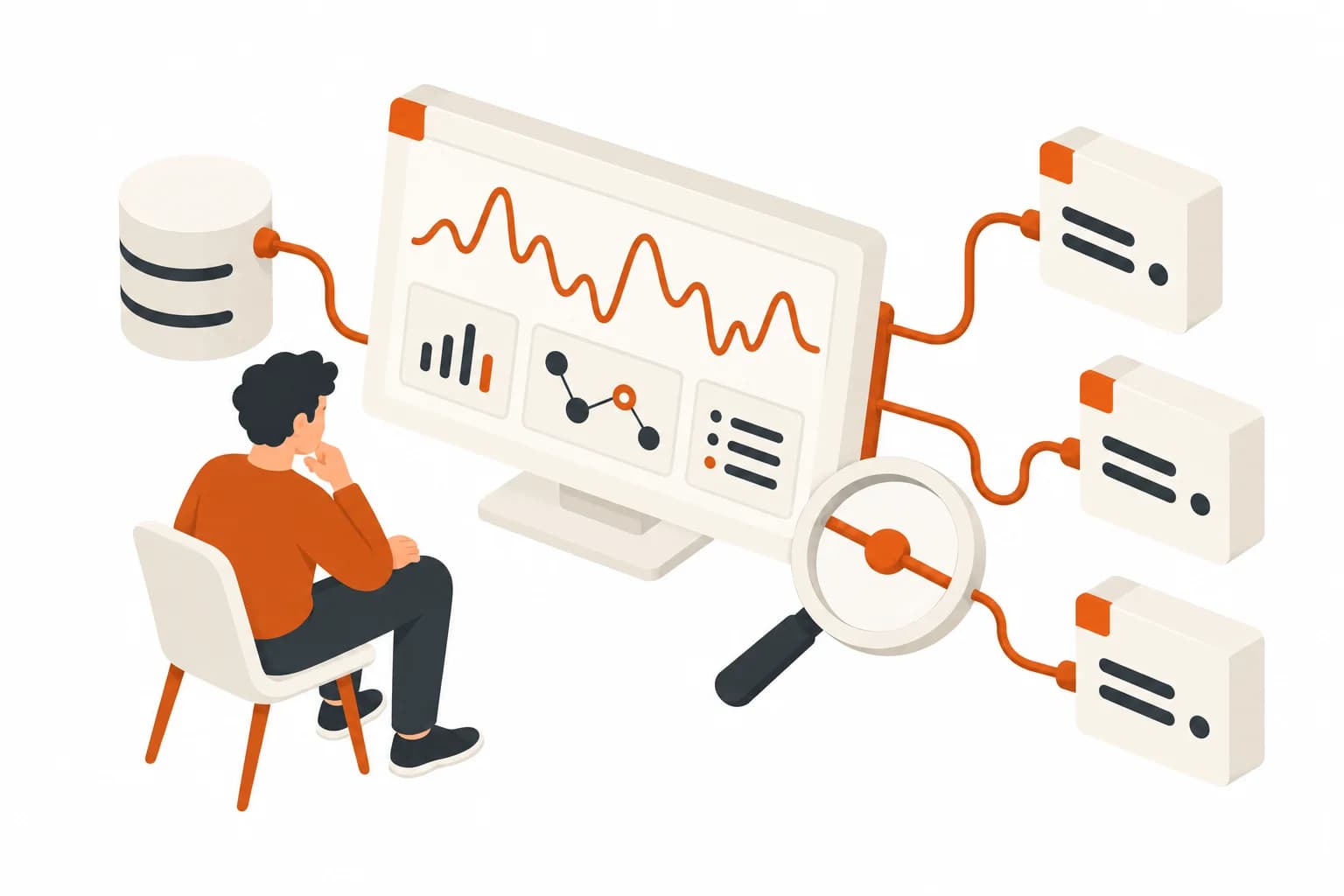
showing 48 of 66 tools

OpenTelemetry-native observability for LLM applications with evals and GPU monitoring
OpenLIT is an open-source AI engineering platform that provides OpenTelemetry-native observability for LLM applications. It combines distributed tracing, evaluation, prompt management, a secrets vault, and GPU telemetry in a single self-hostable stack. With 50+ integrations across LLM providers and frameworks, it lets teams monitor AI applications using their existing observability backends like Grafana, Datadog, or Jaeger.
Open-source observability platform for metrics, logs, and traces visualization.
Grafana is the leading open-source platform for monitoring and observability visualization. It connects to virtually any data source — Prometheus, Elasticsearch, InfluxDB, PostgreSQL, CloudWatch, Datadog, and 150+ others — to create beautiful, interactive dashboards. Used by millions of users at companies like Bloomberg, JPMorgan, eBay, and PayPal. Grafana Cloud offers a fully managed experience with generous free tier. The CNCF ecosystem standard for metrics visualization.

Sentry-style observability for AI agent conversations
Latitude is an agent observability platform for teams that need to inspect LLM traces, conversations, issues, and evaluation feedback in one workflow. Its public repo and docs position it as a Sentry-style monitor for AI agents, with semantic search, issue detection, annotations, MCP-assisted fixes, and cloud or self-hosted deployment paths for production debugging.

Open-source post-building layer for agents — tracing, evals, and online monitoring
Judgeval is the open-source post-building layer for AI agents from Judgment Labs, providing OpenTelemetry-based tracing, hosted and custom evaluation scorers, and online behavior monitoring for LLM-powered applications. Instrument any function with a single decorator, score live production traffic against faithfulness and instruction-adherence checks, and feed real-world failures back into reinforcement learning or supervised fine-tuning loops.

Production monitoring platform for AI agent reliability
Sentrial is a YC W26-backed monitoring platform for AI agent reliability in production. It semantically detects loops, hallucinations, tool misuse, and user frustration in real-time, then diagnoses root causes and recommends fixes. The platform claims 70% MTTR reduction via automated remediation including rollback, model retraining triggers, and webhooks. Sentrial positions itself as the Datadog for teams deploying autonomous AI agents at scale.

Cloud-scale monitoring, security, and analytics platform for modern infrastructure.
Datadog is a cloud observability and security platform that unifies metrics, traces, logs, RUM, synthetics, APM, and security signals. Current pricing pages list 1,000+ integrations for Infrastructure Monitoring, with Pro from $15/host/month and Enterprise from $23/host/month when billed annually.

Open-source product analytics, session replay, and feature flags
PostHog is an open-source product and data tools platform for analytics, session replay, feature flags, experiments, surveys, error tracking, web analytics, data warehouse, CDP and LLM observability workflows. It suits developer-led teams that want one integrated product OS instead of many separate tools.

Open-source LLM observability and evaluation
Phoenix by Arize is an open-source AI observability platform for tracing, evaluating, and debugging LLM applications. It captures prompt-response pairs, retrieval context, agent tool calls, and latency data through OpenTelemetry-based instrumentation. Provides experiment tracking, dataset management, and evaluation frameworks for systematically improving AI application quality. 10K+ GitHub stars.

Open-source LLM engineering platform for observability
Langfuse is an open-source LLM engineering platform with 29K+ GitHub stars for tracing, evaluating, and monitoring AI applications. Acquired by ClickHouse, it provides detailed traces of LLM calls, prompt management with versioning, dataset-based evaluation, user feedback collection, and cost tracking. Framework-agnostic with native integrations for LangChain, LlamaIndex, OpenAI SDK, and Vercel AI SDK. Offers both self-hosted deployment and a managed cloud service.

LLM evaluation and prompt engineering platform
Braintrust is an AI observability and evaluation platform for tracing LLM applications, building datasets, running prompt/model experiments, scoring outputs and turning production feedback into regression tests. It fits teams that need repeatable quality gates for AI releases rather than one-off prompt demos.

Application monitoring and error tracking that helps developers fix issues faster.
Sentry is the leading error tracking and performance monitoring platform for developers. Captures and aggregates errors with full stack traces, breadcrumbs, and context across 100+ platforms. Used by over 100,000 organizations. Features session replay, performance tracing, and code-level profiling. A self-hosted deployment is available under FSL-1.1-Apache-2.0.
AI gateway with observability, routing, and guardrails
Portkey is an AI gateway and observability platform providing a unified API for 200+ LLM providers with intelligent routing, caching, rate limiting, and guardrails. Route requests across OpenAI, Anthropic, Google, and more with automatic failover, load balancing, and cost optimization. Features request logging, prompt management, evaluation tools, and real-time monitoring. The open-source gateway can be self-hosted; Portkey Cloud adds managed observability and team features.

Open-source monitoring and alerting toolkit — the CNCF standard for metrics collection.
Prometheus is the open-source monitoring system and time-series database that has become the CNCF standard for metrics collection in cloud-native environments. Features a powerful query language (PromQL), pull-based metrics collection, multi-dimensional data model, and built-in alerting via Alertmanager. The foundation of modern Kubernetes observability.
SigNoz is an OpenTelemetry-native observability platform for collecting and correlating logs, metrics, and traces. Teams can self-host it or use SigNoz Cloud, with dashboards, alerting, query workflows, and enterprise controls for cloud-native and AI application telemetry.
ML experiment tracking and model monitoring
Weights & Biases is an AI developer platform for experiment tracking, artifact and model lineage, model monitoring, and Weave-based LLM evaluation. It helps teams log runs, compare metrics, manage datasets and model artifacts, and collaborate through dashboards, reports, alerts, SSO/RBAC controls, and hosted or self-managed deployment options.
Zero-instrumentation Kubernetes observability powered by eBPF
Coroot is an open-source observability platform that uses eBPF to automatically instrument Kubernetes applications without code changes. It provides application maps, latency analysis, log correlation, and continuous profiling with automatic anomaly detection. Replaces the need for manual instrumentation with agents that capture metrics, traces, and logs at the kernel level.
Open-source LLM observability through a single-line proxy
Helicone is an open-source LLM observability and AI gateway platform with proxy-based request logging, cost tracking, latency monitoring, caching, rate limits, user analytics, prompt tools, and HQL. It supports OpenAI, Anthropic, Azure, LiteLLM, Anyscale, Together AI, and OpenRouter integrations, and now presents itself as part of Mintlify while continuing managed and self-hosted gateway/observability workflows.

Slack-native incident management with AI SRE agent
Incident.io is a Slack- and Microsoft Teams-native incident management platform with AI SRE investigation, on-call scheduling, status pages, and post-incident learning in one product. Vendor case studies cite Buffer reducing critical incidents by 70% and Favor reducing MTTR by 37%. It integrates with PagerDuty, Datadog, GitHub, Jira, and 100+ tools for incident response and operational workflows.
Open-source platform for the complete machine learning lifecycle.
MLflow is an open-source platform for managing the end-to-end machine learning lifecycle. Covers experiment tracking, model packaging, model registry, and deployment. Created by Databricks and now a Linux Foundation project. Integrates with TensorFlow, PyTorch, scikit-learn, Hugging Face, and all major ML frameworks.

Session reports for Claude Code and Codex runs
Spotlight by Backplanes turns completed Claude Code and Codex sessions into concise reports for engineering, security, and spend review. The CLI installs on macOS, Linux, or WSL 2, watches sessions after they finish, redacts PII and credentials locally before upload, then summarizes files touched, commands run, external domains reached, scope drift, risky actions, and next-session improvements.
OpenTelemetry-native observability with AI tracing, logs, traces, metrics, and session replay — self-hosted in 90 seconds.
Traceway is an open-source, OpenTelemetry-native observability platform that combines logs, traces, metrics, exceptions, session replay, and AI tracing in a single self-hosted system. MIT licensed with no open-core restrictions, it deploys in 90 seconds via Docker Compose and accepts OTLP/HTTP from any OTel SDK without a Collector or per-language vendor SDK.
HyperDX is the ClickStack UI for ClickHouse-backed observability. It provides a frontend for exploring logs, traces, metrics, session replay, dashboards, and alerts, with an OpenTelemetry-centered deployment path for teams that want a self-hosted or ClickHouse-aligned observability stack.

Full-stack observability with AI-powered monitoring
New Relic is a full-stack observability platform combining APM, infrastructure monitoring, logs, traces, browser/mobile monitoring, synthetics, and AIOps. Current public copy highlights 50+ capabilities, 100 GB/month free data ingest, one free full platform user, unlimited basic users, and 800+ pre-built integrations.

LLM evaluation and tracking with RAG triad metrics
TruLens is an open-source framework for evaluating and tracking LLM experiments with feedback functions, RAG triad metrics (answer relevance, context relevance, groundedness), and Honest/Harmless/Helpful evaluations. Features a unified Metric API for systematic evaluation of RAG pipelines and AI agents. 3,200+ GitHub stars, MIT licensed. Snowflake partnership adds enterprise integration. Supports LangChain, LlamaIndex, and custom LLM applications.

Better Stack is a hosted observability and incident-management platform that combines uptime monitoring, on-call workflows, status pages, logs, traces, metrics, error tracking, session replay, and an AI SRE interface. It is aimed at teams that want one SaaS control plane for telemetry and incident response.

Evaluation-first LLM and agent observability
Confident AI is an evaluation-first observability platform that scores every trace and span with 50+ metrics, alerting on quality drops in LLM and agent applications. It goes beyond traditional APM by treating evaluation as core observability, providing actionable insights that help teams understand not just whether their AI applications are running but whether they are producing correct and useful outputs.

Open-source ML and LLM monitoring with 100+ metrics
Evidently AI is an open-source platform with 100+ pre-built metrics for monitoring data quality, model performance, and data drift in AI/ML pipelines. Available under Apache 2.0 with a cloud version, it helps teams detect when production data shifts away from training distributions, LLM output quality degrades, or feature pipelines introduce anomalies that silently degrade model accuracy.
Full-stack observability platform with OpenTelemetry-friendly telemetry, LLM observability, and AI SRE workflows.
Middleware is a full-stack observability platform for infrastructure, APM, logs, metrics, traces, RUM, synthetics, browser testing, LLM observability, and AI SRE workflows. It targets teams that want OpenTelemetry-friendly telemetry, faster incident correlation, and a 14-day free trial before Pay As You Go or Enterprise observability commitments and rollout planning.

CNCF Sandbox Kubernetes alert enrichment and automation platform
Robusta is a CNCF Sandbox project that enriches Kubernetes alerts with diagnostic context and automates remediation workflows. It intercepts Prometheus alerts, attaches relevant logs, pod status, resource metrics, and troubleshooting suggestions before delivering them to Slack, Teams, or PagerDuty. Supports custom playbooks for automated incident response and AI-powered root cause analysis.
LLM observability and evaluation by Weights & Biases
W&B Weave is the LLM observability and evaluation toolkit from Weights & Biases. It provides automatic tracing of LLM calls with full input/output logging, cost and latency tracking, evaluation pipelines with custom scorers, and a trace explorer for debugging multi-step agent workflows. Integrates with OpenAI, Anthropic, LangChain, and CrewAI via simple Python/TypeScript decorators.

Open-source LLMOps platform for prompt management and evaluation
Agenta is an open-source LLMOps platform that combines prompt engineering playgrounds, prompt version management, LLM evaluation, and observability in a unified interface. It supports 50+ LLM models with side-by-side prompt comparison, A/B testing, human evaluation workflows, and OpenTelemetry-native tracing. Self-hostable with 4,000+ GitHub stars.

AI-driven log analysis with zero false positives
Dash0 is an AI-driven observability platform focused on log analysis that auto-structures unstructured logs, provides instant alerting with zero false positives, and delivers full-stack tracing capabilities. It uses AI to transform raw log data into structured, searchable events without requiring manual parsing configuration, making log-based debugging significantly faster for engineering teams.
Open-source observability for AI agents
Laminar is an open-source observability platform for AI agents providing tracing, evaluation, and analytics for LLM applications. It integrates with Vercel AI SDK, LangChain, OpenAI, and Anthropic with a single line of code. Features include OpenTelemetry-native SDKs, an extensible evaluation framework with CI/CD support, SQL access to traces and metrics, and a visual debugging timeline for agent reasoning and actions.

LLM evaluation and tracing by Comet
Opik is an open-source LLM evaluation and tracing platform by Comet ML for debugging, testing, and monitoring AI applications. Provides detailed traces of LLM calls with latency, token usage, and cost tracking. Features automated evaluation with built-in and custom metrics, dataset management for regression testing, and production monitoring dashboards. Integrates with the broader Comet ML experiment tracking ecosystem. Available as both self-hosted open-source and managed cloud service.

Observability platform purpose-built for Python and Pydantic AI apps
Pydantic Logfire is an observability platform built by the Pydantic team specifically for Python AI applications. It provides structured logging, distributed tracing, and metrics with native understanding of Pydantic models, FastAPI, and AI framework data types. Auto-instruments OpenAI, Anthropic, LangChain, and other LLM providers. Built on OpenTelemetry for vendor-neutral data export. Offers a managed cloud dashboard with a generous free tier for development and small-scale production use.

Observability and lifecycle management for AI agents
AgentOps is an observability platform for monitoring, debugging, and managing AI agents. It provides session replay, event timelines, tool-call and LLM tracing, cost tracking, and dashboards for multi-agent workflows. Integrations span OpenAI, CrewAI, AutoGen, LangChain, LangGraph, LlamaIndex, Google ADK, OpenAI Agents, xAI, and 400+ LLMs/frameworks.

AI observability with security posture management
Coralogix uses AI to provide actionable insights across logs and traces with a dedicated AI-SPM dashboard for tracking prompt injections and data leaks in AI applications. Its pay-per-use model with no upfront fees integrates security posture management directly into the observability stack, making it uniquely positioned for teams running both traditional and AI-powered production workloads.

Self-evolution engine for AI agents with auditable updates
Evolver is an open-source self-evolution engine for AI agents that turns run logs into auditable, reviewable updates via its Genome Evolution Protocol. Instead of ad hoc prompt tweaking, teams collect traces and Evolver proposes versioned diffs to prompts, tools and workflows that engineers can approve, reject or roll back like code.

LLM application observability and evaluation platform
LangSmith is LangChain's platform for debugging, testing, evaluating, and monitoring LLM applications in production. Provides detailed tracing of every step in LLM chains and agent workflows, dataset management for regression testing, prompt versioning, and automated evaluation with custom metrics. Features an annotation queue for human feedback, online monitoring dashboards, and integration with LangChain, LangGraph, and any LLM framework via the Python/JS SDK. Essential for production LLM ops.

Multi-agent simulation and LLM evaluation platform
Maxim AI is an evaluation and monitoring platform for LLM applications with multi-agent simulation capabilities. Features automated test generation from production traces, custom evaluation metrics, regression detection, and real-time monitoring dashboards. Supports simulating multi-turn conversations for testing chatbots and agents at scale. Provides prompt versioning, A/B testing, and integration with CI/CD pipelines for continuous quality assurance of AI outputs across deployment cycles.

Data and AI observability for enterprise teams
Monte Carlo is the leading data and AI observability platform using ML to monitor pipelines, warehouses, and lakes for quality issues. It detects freshness delays, volume anomalies, schema changes, and distribution shifts before they impact analytics. With 500+ deployments at Nasdaq, Honeywell, and Roche, it provides automated root cause analysis, field-level lineage, and incident management. Available on AWS and Azure Marketplace.

OpenTelemetry-native LLM observability instrumentation
OpenLLMetry by Traceloop is an open-source instrumentation library with 7,000+ GitHub stars that adds OpenTelemetry-native tracing to LLM and AI agent applications. It captures detailed traces of model calls including latency, token usage, costs, and error rates, exporting data to any OpenTelemetry-compatible backend like Grafana, Datadog, or Jaeger for vendor-neutral AI observability.

AI agent testing and LLM evaluation platform
LangWatch is an AI agent testing, LLM evaluation, and observability platform for production AI teams. It combines traces, evaluations, scenario simulations, guardrails, prompt management, and Optimization Studio/DSPy workflows, with cloud and self-managed options for teams that need release-quality feedback loops.

AI-powered SRE agent for Kubernetes troubleshooting
Metoro is an AI SRE platform for Kubernetes that combines observability with autonomous troubleshooting. Its Guardian agent monitors cluster health, correlates metrics, logs, and traces to identify root causes, and suggests remediation actions. Features an MCP server for integration with AI coding agents and natural language querying of infrastructure state.

Framework for evaluating LLM and agent performance
OpenAI Evals is an open-source framework and benchmark registry for evaluating LLM performance on custom tasks. It provides infrastructure for writing evaluation prompts, running them against models, and recording results in a structured format for comparison. The hosted Evals API on the OpenAI platform adds managed run tracking, dataset management, and programmatic access to evaluation pipelines. With 17,700+ GitHub stars, it serves as a foundation for systematic LLM quality measurement.

All-in-one open-source observability — logs, metrics, traces, RUM
OpenObserve is an open-source observability platform that unifies logs, metrics, traces, and real user monitoring in a single binary. It claims 140x lower storage costs than Elasticsearch through columnar storage and compression, with native OpenTelemetry support, a built-in query UI, dashboards, and alerts. Designed for AI and cloud-native workloads at petabyte scale. Over 15,000 GitHub stars.

Industry-standard incident management and on-call alerting platform
PagerDuty is an enterprise incident management platform for on-call scheduling, alert routing, escalation policies, and incident response orchestration. It integrates with 750+ monitoring, ticketing, cloud, and collaboration tools, including Datadog, Slack, Jira, AWS, and Microsoft Teams. Current pricing lists a Free tier for up to 5 users, Professional from $21/user/mo annually ($25 monthly), Business from $41/user/mo annually ($49 monthly), and Enterprise custom.

Prompt registry, observability, and evaluation workflows for LLM applications.
PromptLayer is a prompt management, observability, and evaluation platform for LLM applications. Teams use its Prompt Registry, visual editor, request logs, Tables, evaluations, Tool Registry, and Skill Collections to version prompts, replay requests, compare variants, run datasets, and ship prompt changes without redeploying code. Pricing starts with Free $0 for 5 users and 2.5K requests/month, Pro $49/month, Team $500/month, and Enterprise custom.
Community tiers
A different perspective: rank the tools you know from S to D.
Sources & verification
Verification dates are editorial checks. Routine CMS saves and automatic updatedAt timestamps do not advance them.